Posted on: Loading...
Loading...
Est Reading Time: Loading...Loading...
Loading...
tl;dr Yes, but no.
Something that I've always heard is that how Melbourne public transport is always super expensive. I've been living overseas in Taipei for the past 5 to 6 years and it has always makes me wonder if its really that expensive.
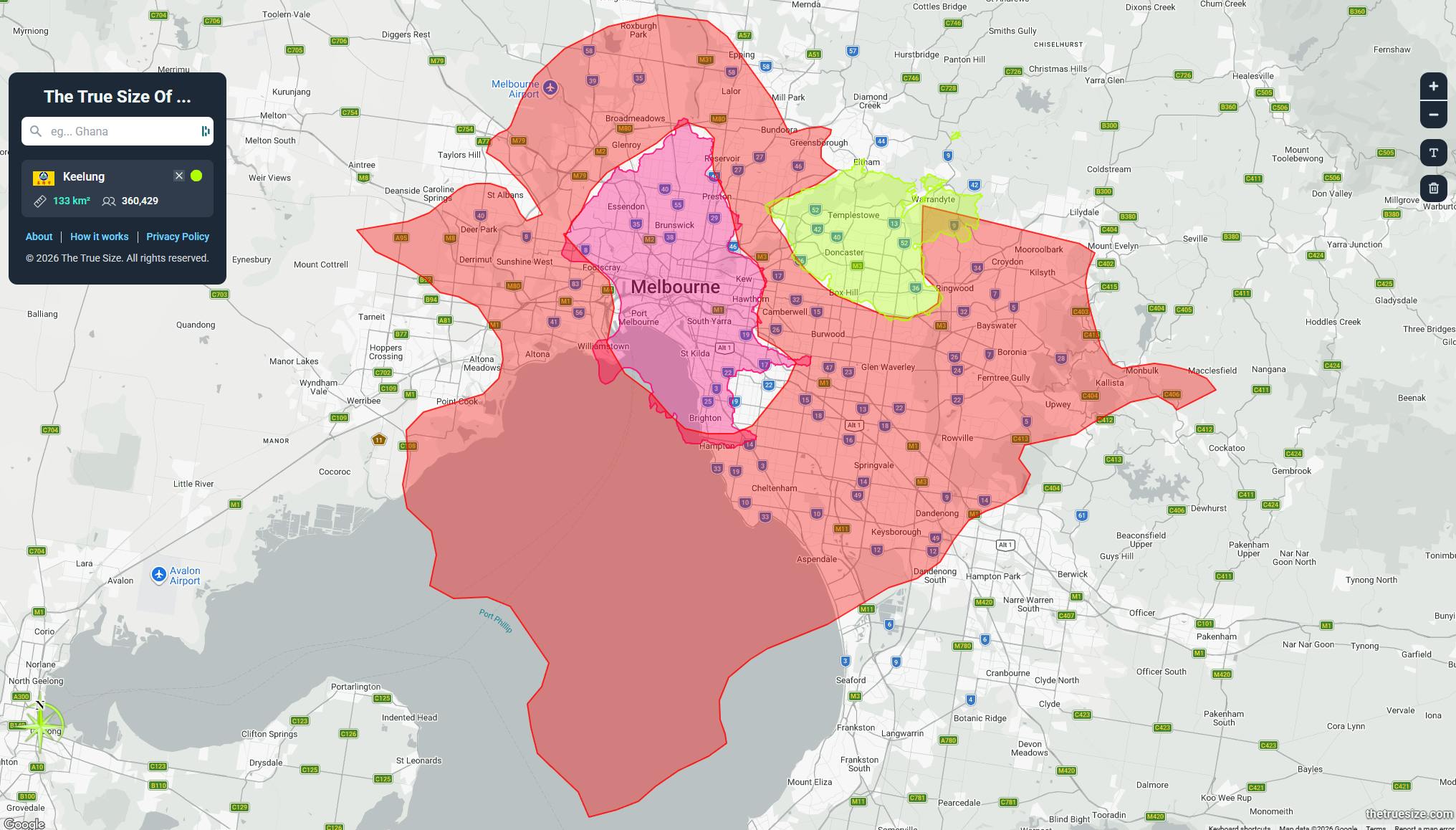
Taipei, can really be separated into 2 parts - "Greater Taipei", and Taipei. However, the monthly T-Pass covers the "Cities" (or similar to Australian "States/Territories") of:
This means that the T-Pass covers approximately to over 9.2 million residents and a land area of just slightly over 3600km². In comparison Melbourne has a population of 5.2 million residents and a land area of around 2,453km².
Naturally, this would mean that moving people around in Taipei with public transport is going to be cost effective, given the amount of people per land-area.
From here on we going to assume an exchange rate of A$1 = NT$22.
The monthly T-Pass currently costs around NT$1200 (around A$53.86 a month, as of February 2026), while Melbourne's myki monthly pass, assuming a 28-day lands around A$6.84/day (Feb 2026) assumung you travel between Zone 1 + 2, assuming a 30 day month, this would cost around A$205/month.
From here let's assume that you would be using a Full-fare based pricing and no-passes, no-concessions or anything.
We are also going to assume that we are looking at rail-based solutions (Trams, Light-Rail, Metro and Trains) as Taipei buses charge differently to Metro.
Melbourne uses zoning areas, and hourly-based pricing, for instance a base fare would typically be either a 2-hr pass or a daily pass. Assuming you travel in Zone 1 (this fare also includes Zone 2), this would cost $5.70 (2hr) and $11.40 (daily) respectively as of February 2026. (note: Melbourne also has a free tram zone which means you dont need to tap-on or off if you are just travelling within the zone.
Taipei's Metro (or MRT) uses distance based with the base fare being at least NT$20 (A$0.91) and with no-daily cap, but instead has a distance cap of NT$65 (A$2.95).
Back in Taipei, I live in the Banqiao District -which is one of the most populous district in New Taipei City. Assuming I work in the CBD equivalent, around Taipei 101. It would take me approximately 52mins by MRT to get to work.
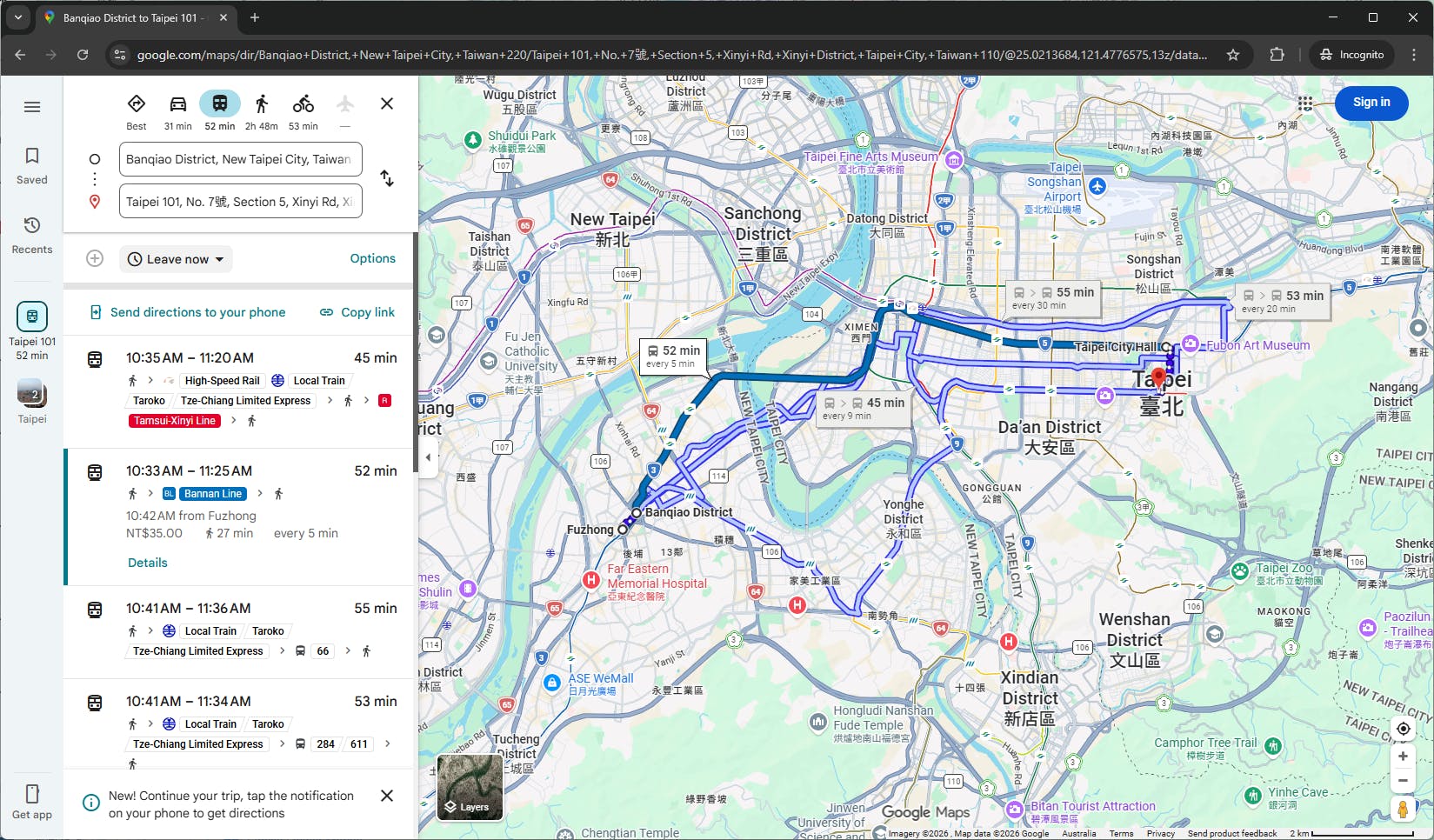
This would take 15.6km by car, or 30mins. typically.
Now back home, a similar distance would be Murrumbeena to Southern Cross, which is around 15.6km by car, or around 52 mins by Train with a change at State Library/Melbourne Central to get to Southern Cross.
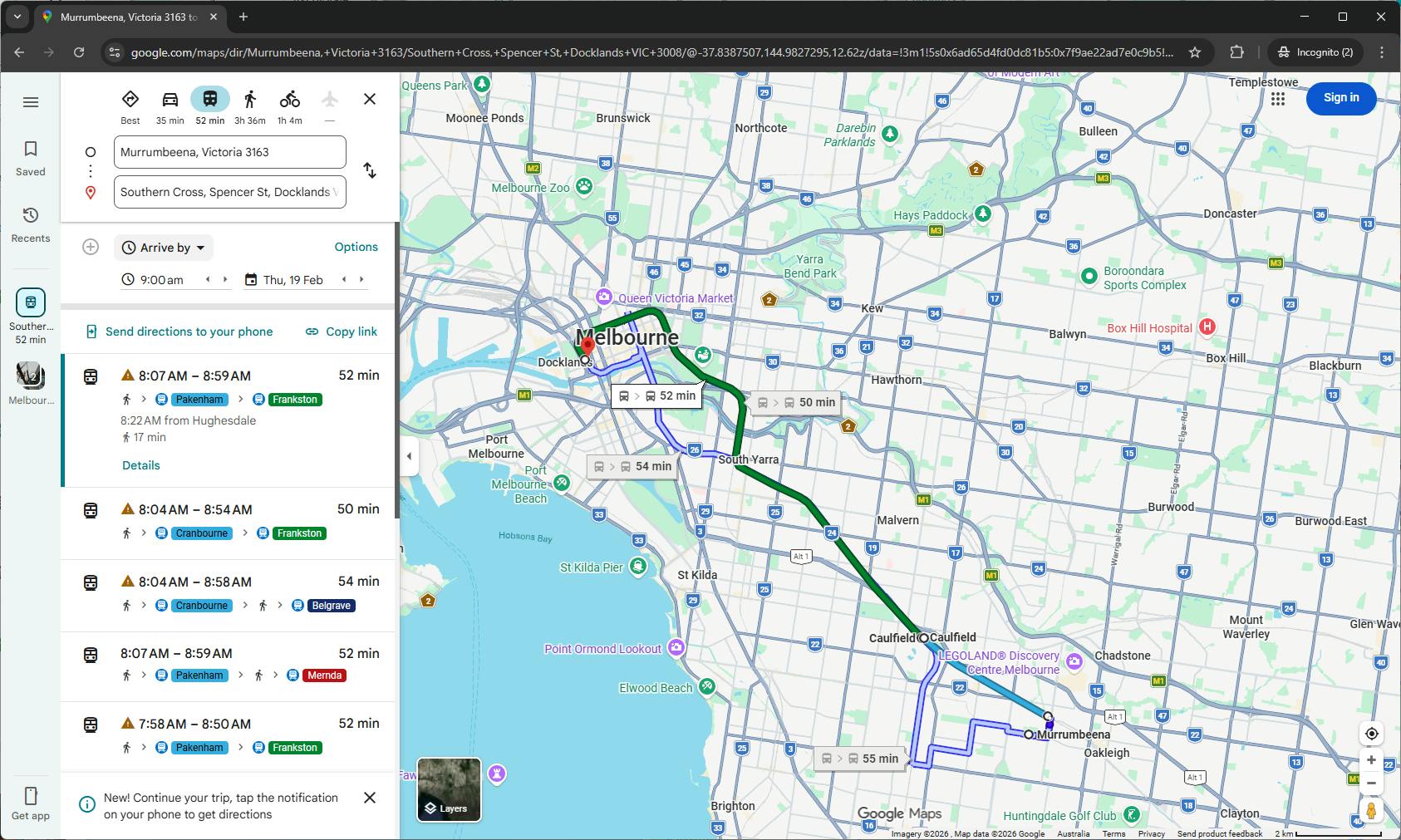
To get from Banqiao to Taipei 101, it would cost me N$70 (or A$3.18) per day. Meanwhile in Melbourne this would cost me A$11.40 per day.
This works out to be:
There is just one important thing that we forgot to factor in - average income (and also cost of living).
Here we dive into the main cost, lets assume that we don't get the monthly pass for now.
The average monthly wage for financial and insurance companies was NT$107,348. After tax of 20% this would mean an approximate take-home income of NT$85,878, this would mean that 1.6% of the salary would be spent on transportation alone.
While a Financial Analyst in Melbourne would around A$105k-A$125k (Seek, 2026). Let's take the middle number of A$115k and a tax rate of 30%, this would mean that the annual take-home is A$80,500 or A$6700/month. If we take the A$228/month and divide by the monthly take-home, we get approximately 3.3%.
Okay, now we see that its actually more reasonable, but still almost double of what a typical profressional in Taipei might spend in proportion to their income.
I write this post in Melbourne, as I came back for the Lunar New Year to spend time with my family. But before I came back I had to do a lot of snack/souvenir shopping to share with friends and family.
For example, on the 31st Jan 2026
This would mean that i spent approximately: NT$115 just to get around for the day, if Taipei introduced a hourly-based instead of distance-based I would save a bit more money.
I would think Melbourne is more expensive, sometimes you may need to only ride 1-or-2 stops, but not necessarily for the whole 2 hours (unless if you are trying to get to the Airport, lol).
Monthly-passes a way to save money, even in Taipei - I used to travel to and from the other side of Taipei, this trip would cost NT$30 per trip or NT$60 per day, or NT$1200/month, meaning that if I got the monthly pass, I would technically get "Free weekend" travel. But also TPass is subsidised by the government, so when government budgets don't pass, they get threatened to be stopped.
So yeah, even in Taipei the public transport can get expensive (and that's not even comparing to a more exxy place like London!).
So yeah, the answer to the question is Melbourne Public Transport really that expensive would probably be a Yes, but no.
Governments can probably find ways:
Even in Taipei I take buses to work not only because its cheaper option but also its super reliable the route I take is usually 10 to a max of 20 mins per bus.
I would argue that cheaper hourly/daily fares wouldn't 100% solve the problem. To maintain fair pricing you can't just charge the cheapest possible amount, otherwise just running the public transport wouldn't be sustainable in the long-term and cost a lot more to the taxpayer.
Another idea is to introduce a fare system where its distance-based, but with a daily cap.
But maybe that is too complex for Melbourne's myki system, or for another blog post.